
What the colour rendering index tells you
The colour rendering index — CRI — describes how naturally an artificial light source renders the colours of an object. Daylight is the reference, with a value of 100. The further a lamp falls below it, the more it shifts colours: reds look dull, skin tones look washed out, fine differences disappear.
Since incandescent bulbs gave way to energy-saving and LED lamps, the figure has mattered to consumers. An incandescent bulb rendered colours almost perfectly because it emits a continuous spectrum. LEDs produce their light differently and can have gaps in that spectrum.
How the Ra value is measured
A spectrometer measures how the test light source renders eight standardised reference colours and compares the result with the reference light. The average of those eight values, R1 to R8, is the general colour rendering index Ra — the “a” stands for general.
Worth knowing: saturated red, the R9 value, is not part of that average. Two lamps with the same Ra can therefore render reds quite differently. Wherever red matters — skin tones, paint colours, coloured wiring — it is worth looking for R9, if it is stated at all.
Reading the values
- Ra 90 and above — very good colour rendering
- Ra 80 to 89 — good colour rendering, enough for most work
- Ra below 80 — not advisable where colours are being judged
Typical values by lamp type
| Lamp type | Ra value |
|---|---|
| Incandescent bulb | ≈ 100 |
| Halogen lamp | ≈ 98 |
| White LED | ≈ 70–95 |
| Fluorescent lamp | ≈ 50–90 |
| High-pressure mercury vapour lamp | ≈ 45–50 |
| Black light | ≈ 0 |
Why colour rendering matters on a magnifying lamp
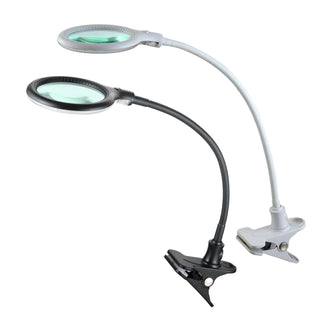
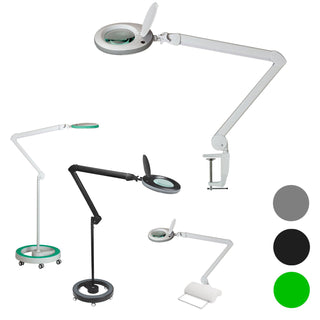
A magnifying lamp does not only magnify — it is also the light under which the work is judged. In nail design it decides whether a mixed shade still looks right in daylight. In cosmetics it is about skin tones. When soldering, good colour rendering helps you tell resistor bands and coloured wires apart; when painting miniatures, it reveals fine gradations.
If you mainly need to see contours — reading, assembly, checking edges — an Ra around 80 serves you well. If you judge colour, choose the higher value.
Do not confuse CRI with colour temperature
Both describe light, but different things. Colour temperature in kelvin says whether light feels warm or cool. CRI says how true colours look under it. A light can be daylight-white and still render colour poorly.
What to check before you buy
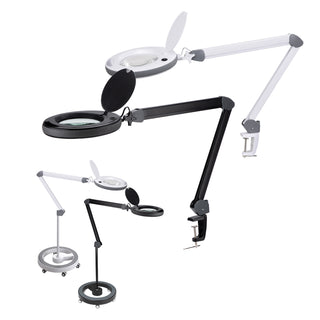
First check that an Ra value is stated at all — a missing figure is rarely a good sign. Judge it together with brightness and light colour rather than on its own: very bright light with weak colour rendering tires the eyes faster than the lumen figure suggests. The values for each Lumeno series are listed in the technical data on the relevant product page.


0 comments